Their long necks leaned into our open palms and something in their grace made time loosen its grip. Two young giraffes leaned over the railing, their dark eyes reflective, their lashes long as reeds. Their tongues, rough and wet, brushed our hands, curling for the small pellets we held between our fingers. The platform lifted us high enough to meet them eye to eye. We stood beside them, touching their gentle faces. They moved unhurried, unstirred by our nearness, untouched by the small flurry we carried with us. They had known other hands, other days.
When we left, we carried a strange lightness, as if we had been allowed briefly into the space of something larger, something wild, yet so gentle. Like the first stride before a long walk, the giraffes carried us beyond the city and into the widening wilderness.
A light rain began to fall. Mist rose from the edge of the road and slipped through the open windows, cool against the skin. The hills ahead disappeared behind the cloud and the vehicle turned again and again, climbing then descending until the world outside was nothing but grey.
No one spoke much. There was nothing we could see, only the feeling that we were moving downwards, deeper into something, somewhere.
Ngorongoro, the driver said.
The word lingered, sitting heavy between us.
Then, the mist lifted, the cloud broke apart, and the land opened in front of us all at once. A vast green bowl stretched in every direction, so far that the distant edges disappeared into mist. An ancient eruption had folded the earth into itself two million years ago leaving behind this quiet enormity.
The air hung heavy with moisture after the rain. Grass grew thick and long, fed by ash. What had once burned lay now as mineral-rich soil. Herds moved across the floor of the crater without urgency. Wildebeest, zebras, cape buffaloes, gazelles, their numbers too many to hold in the eye. Lions lay in the open, hyenas passed among them. Nothing fled. Nothing gave chase. There was no drama here, only a kind of older order.
We watched the elephants from a distance, at first only the slow flapping of their ears moving in line. The jeeps gathered in rows and waited. Time ticked away. Cameras raised in anticipation. The herd came on without a change of pace. They crossed the road and left their prints, large and small, a passing script pressed into the earth.
Inside the crater, everything seemed to belong exactly where it was, and nothing needed our presence to continue. Outside the crater, the land opened into plains that had no beginning and no end. The road ran forwards in a thin line of dust and the horizon moved with us, always widening, never to be reached.
Out in the savannah, the ungulates appeared as shapes, dark against the pale grass. Then the shapes multiplied, gathered, thickened, until the ground itself seemed to be shifting, their bodies spread across the plains in numbers too large to follow. They moved in one direction, clockwise, as if the land was pulling them forwards with an invisible force and energy. An energy driven by the will to survive, where rain and grass were in abundance, where breeding grounds pulled the herds in a slow circle between the Serengeti and the Maasai Mara.
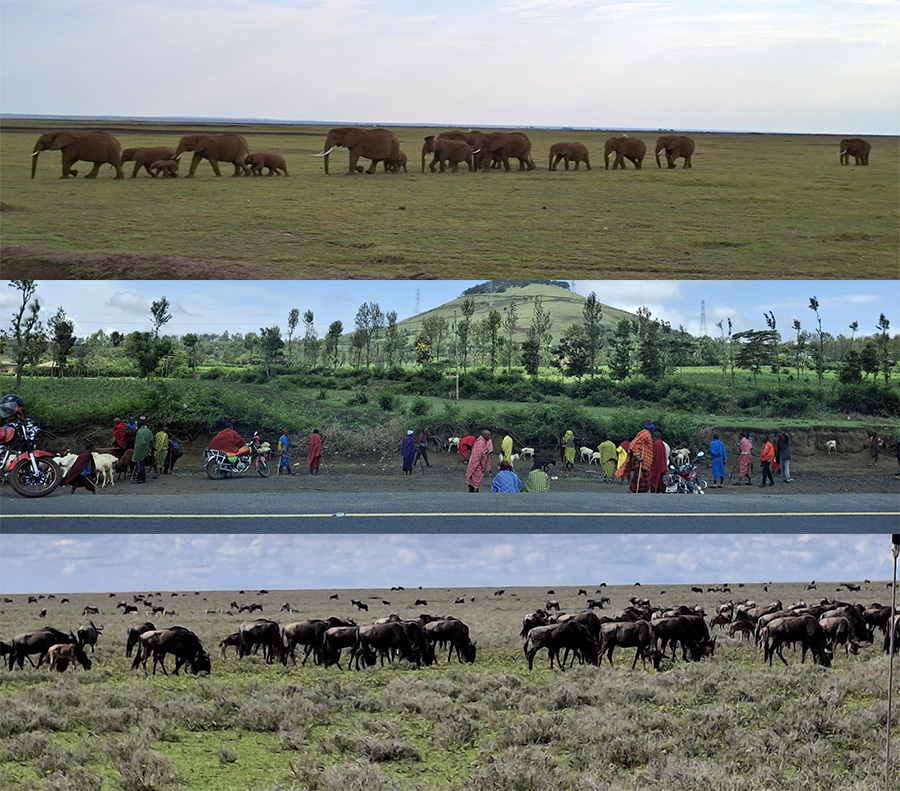
The jeep drove alongside them, keeping pace for a while, then falling behind, then catching up again. From the open roof, Little A stood with his carved lion in one hand, his head turning side to side as he scanned the plains, calling out to the driver whenever he spotted movement in the distance. For a while, we believed we were part of the moment. Then the herd drifted towards the horizon, and the land returned silent.
No single animal seemed to lead. No signal was given. Yet the entire horizon shifted together like a never-ending cinematic take. We followed the movement for as long as the road allowed, then away from it, then back again, as though trying to understand something that could only be seen while it was already disappearing into the distance.
Later, the drives became longer, the roads muddier, the days stretching without much sense of distance. We stopped often when another vehicle was already waiting, its roof lifted, its passengers standing in anticipation, cameras resting on the edge pointing towards something.
A pride of lionesses and their cubs lay in the open grass, close enough to see the rise and fall of their breath. No one spoke loudly, afraid that the moment might disappear. One lifted her head, glanced past the line of jeeps, then lowered again. Another stretched, turned onto her side, cubs huddling in her embrace. Out in the distance, the males lay stretched in the playa, the tips of their tails flicking against the dust in the open heat of the afternoon. The vehicles formed a loose circle around them. The lions did not move. They blinked, yawned, and slept on; the gathering of cameras meant no more than the passing of the clouds.
At the periphery, other predators waited. We waited too, though for something else. A movement, a signal, a moment that would make the waiting feel justified. A pair of cheetahs hidden in the tall grass as the herds passed, unaware or unwilling to know.
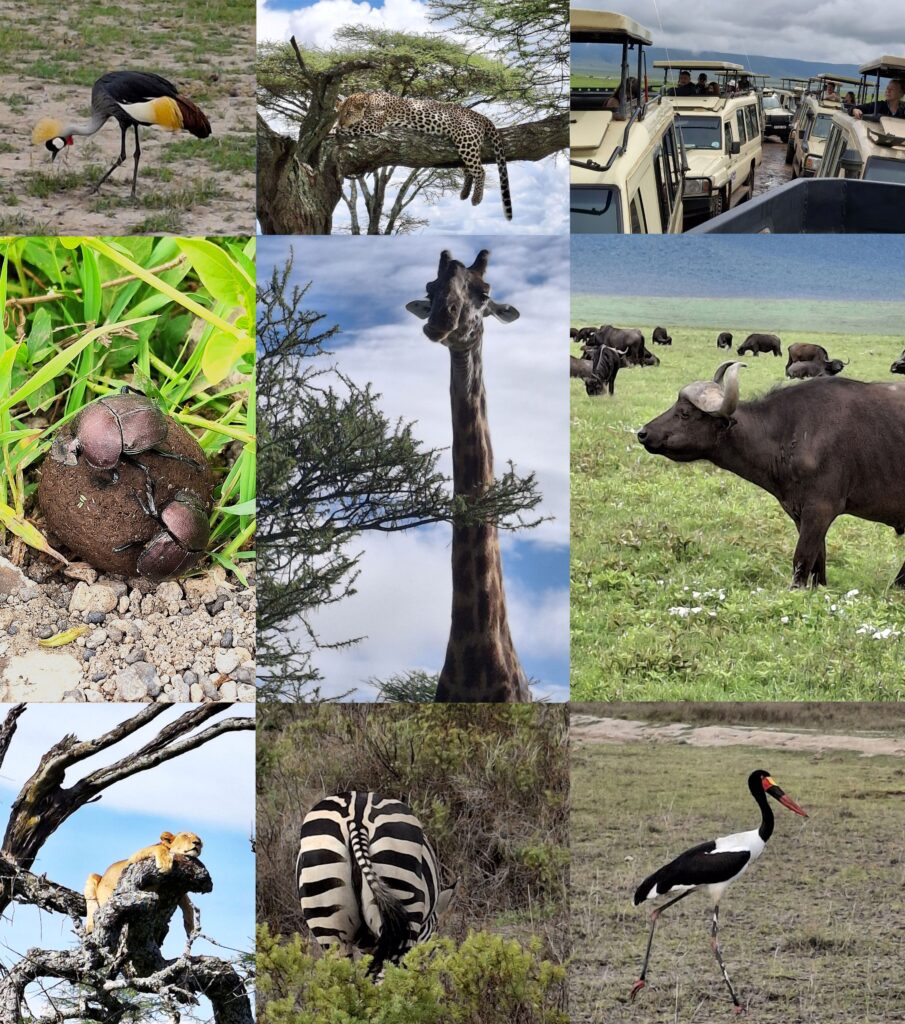
The radio crackled. A message. A leopard, close. Draped along a branch in the shade, it watched. The jeep drew in. I lifted my phone with the rest, leaning for a better angle, wanting what they wanted. A closer frame, A cleaner claim. The leopard looked on, its gaze passed over us. Time passed. It rose. The rosettes along its coat shifted and flowed as it walked the length of the branch through the broken light of the acacia leaves. It settled again, hind legs dangling, head down on its paws.
We stayed to believe the nearness meant something. We stood in our metal and watched a wild thing that did not mark us, did not turn away. It was no longer clear who had come to see whom, only that we had fallen into each other’s gaze, circling, pausing, moving on.
Then we moved on, engines humming, radios alive, always searching. The ease of it. The closeness. A ring of men and metal beneath a tree and the animal above us. Neither fled nor fought. I try to understand it now. Why did the leopard not react? Why did the lions not stir? Whether we had become no more than another passing shape in the heat, I ponder and find no answer.
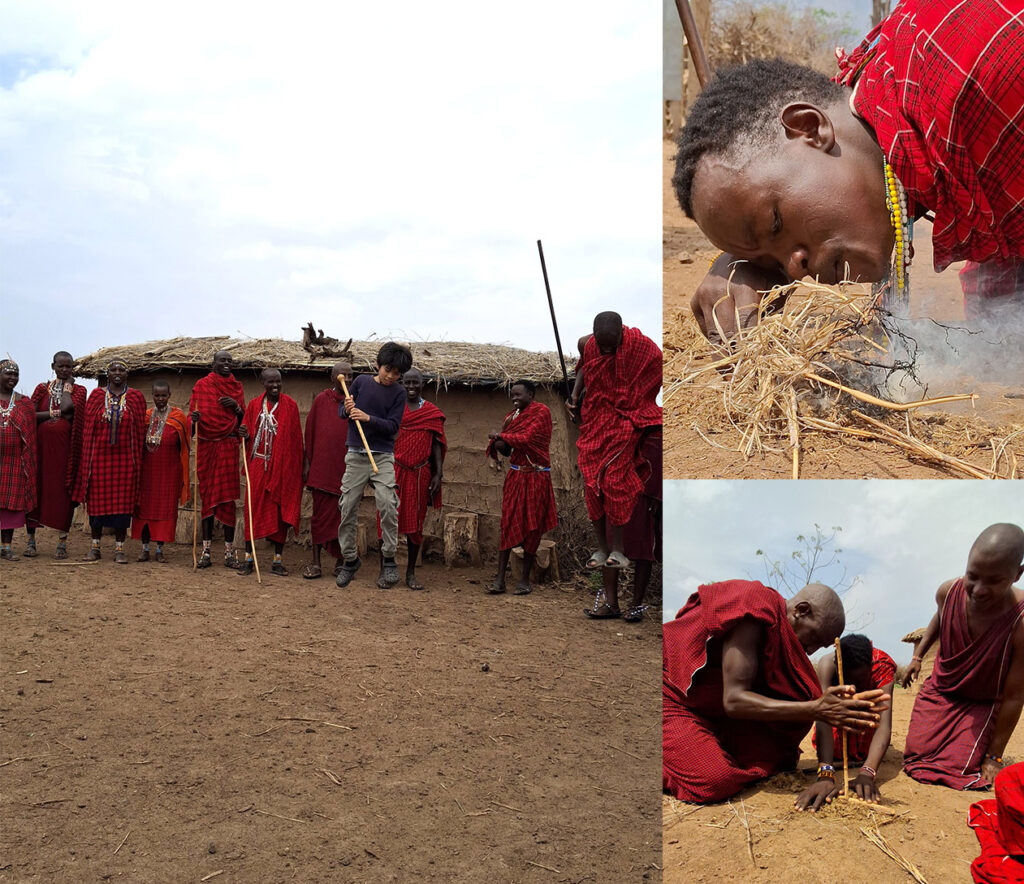
On another day, we drove to a Maasai village set apart from the road by a low fence of branches. A man stepped forwards as we arrived and spoke first about a contribution fee, the amount in American dollars, only after which did the greetings begin. The men wore a shuka wrapped around their shoulders. The women stood beside them, bright with beadwork that caught the light every time they swayed. They placed the necklaces over our heads, one after another, as exhibition pieces for sale. Someone demonstrated how to make a fire. They rolled a dry stick inside a dent of a piece of soft wood until smoke appeared, then sparks, then flame. Adobe houses stood close together in a circle, walls made of mud, dung and grass, small openings cut low to keep the heat out.
Everything was shown to us carefully as if following a sequence that had been repeated many times before.
We watched. They watched us watching.
By the time we drove away, the dust had begun to close behind us and the scene we had just left felt strangely complete without us.
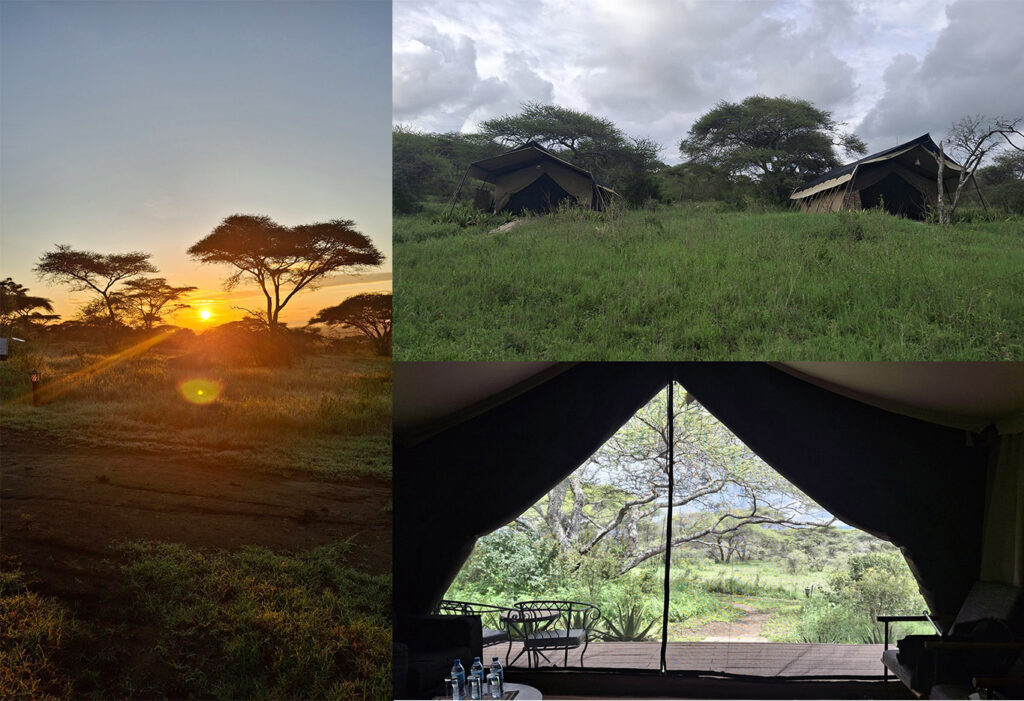
At night, we slept in tents. Not the kind that scouts move around with but large canvas structures supported by sturdy wood, equipped with power and plumbing, and decks. Each camp was a wide expanse built solitarily in the middle of the plains. The first camp in Amboseli had paths that shared with birds. Ostriches wandered around the dining and the pool decks. Peacocks and guinea fowls scattered on the grounds. The beds were too comfortable for a place where elephants could pass in the distance. It felt like the edge of the wild, close enough to hear, far enough to sleep without thinking too much.
As we reached the tents near Lake Masek, the nights began to sound different. After dark, the lake poured its inhabitants into the bushes around us. Hippos grunted, wildebeest moaned, zebras snorted, and somewhere in between it all, a steady, determined chewing carried on throughout the night, close enough to make the canvas walls feel just like a boundary. At some uncertain hour before dawn, I woke with a sense of purpose. Someone, somewhere, had been eating with remarkable dedication, and I felt obliged to identify them. Torch in hand, I cast a beam into the dark. It returned immediately in the form of two bright eyes, caught mid-bite. For a moment, we stared at each other, wondering who had interrupted whom. By daylight, on the path between tents, two shiny dung beetles did what they were expected to do, rolling their improbable burdens as if the weight of the earth depended on them. It was hard not to admire the conviction.
News arrived carried through screens and passing conversations. There was talk of war, of tensions unfolding between countries far from where we stood. Names mentioned, decisions announced, routes reconsidered.
The plains continued as they had the day before. The herds moved across the horizon without pause, the rhythm of their steps unaltered by anything that had been said elsewhere. The nights remain full of sound, the tents still held their shape against the wind, and the mornings arrive with the same slow certainty.
At some point, we were told that our return would be different. The route we had expected would no longer be possible. There would be another flight, another city, another airport in between. The details shifted urgently.
We adjusted as travellers do.
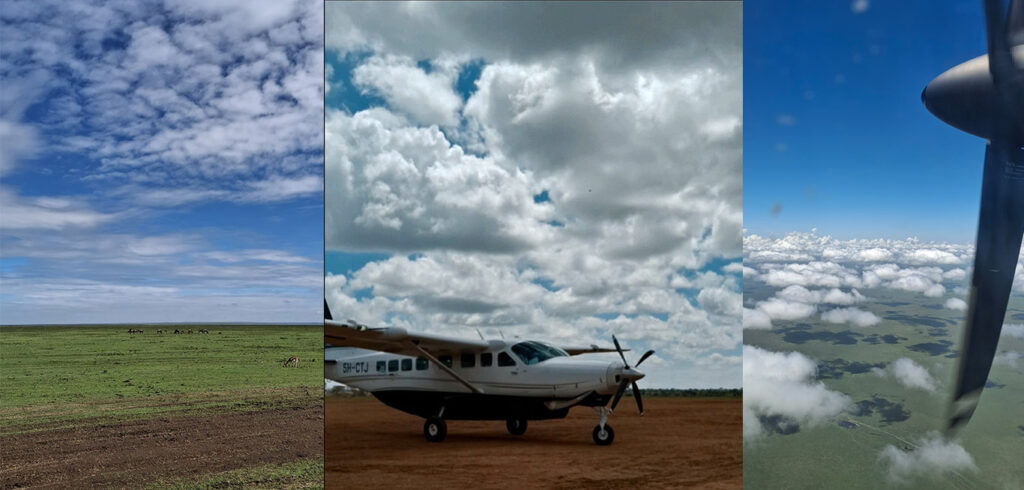
On our last morning, we drove to a small airstrip cut into the earth at Seronera. The ground was dry, dust lifting lightly behind the wheels as we came to a stop. A hold of land, flattened enough for small propeller planes to arrive and leave, stretched out along the horizon.
As the plane lifted, the airstrip fell away quickly, vehicles shrinking into still shapes, the people into nothing at all. The plains opened beneath us, wide and uninterrupted, the same expanse we had spent days crossing now held in a single view.
From above, the land rearranged itself.
Large, dark patches appeared across the savannah, scattered and irregular, like bodies of water reflecting the sky. They seemed too large, too still to be anything else. I tried to make sense of their shape, their presence, to understand how such vast pools could exist in a place that had felt so dry underfoot.
The higher we rose, the clearer they became. They were not water, but shadows.
Low-hanging clouds drifting just above the land, their forms pressed so close to the ground that they cast entire landscapes in darkness. From the plane window, we could see the full fluff, suspended, moving slowly, indifferent to how they altered what we saw below.
The plains themselves remained bare, almost treeless, broken only by the occasional acacia. What I had taken for something fixed revealed itself as something passing. The borders that had required so much negotiation on the ground were invisible now, replaced by a continuous stretch of earth that did not seem to recognise the lines drawn across it. We continued to rise higher, and the savannah dissolved into the colour of sky, the movement below a blur.
The animals did not turn, the land did not change. Whatever it was that I thought I had understood stayed behind, somewhere beneath the clouds.
Yet, the closeness lingered. As a memory and a question that would not settle. Whether what we had felt as nearness was ever ours to claim. Whether the distance had only appeared to narrow because we had learned briefly how to enter without being seen. We had moved through the savannah in our circles, held at the edge of something that did not yield.
From above, it looked whole, uninterrupted, untouched.
But I knew the tracks were there. The circling, the waiting. The insistence of our presence, passing through and calling it an encounter. I could not tell, even now, if we had come close to the wild, or if we had only brushed against it, mistaking our own reflection for entry. And beneath it all, there is an uncertainty whether the wild ever truly admits us, or whether we move always at its edge believing the threshold has opened.
We speak of origin, of having come from the wild. Yet standing there, it did not know us.