Kali, our beloved buffalo, has recently given birth and decided that scarcity is a ridiculous concept. Postpartum and positively luminous in her own way, she produces milk in quantities that feel vaguely mythological, even after Seti, her beautiful calf, has drunk herself into a blissful stupor. By nature’s design, the more suckled, the more the maternal body gives. In this generous economy, human hands coax her into giving more. And she does. Ah, the miracle of motherhood. She feeds not only Seti, but the entire human appetite orbiting her shed.
Hail Kali. Goddess of milk, mud, and moods.


So what do we do with unadulterated milk from a mother buffalo who gives in buckets when she feels generous? Bear in mind, her generosity comes with a bargain, often on her terms. Grazing freely on the land is non-negotiable. Confinement is an insult. She lets the world know exactly how she feels about it. Loudly. With a look that could curdle milk on sight. I mean, who wouldn’t?
Back to the matter at hand.
Here in the village, when one has drunk too many cups of milky chai and the body tips gently from contentment into excess, it becomes clear that transformation is required. Words like curd, ghee, and paneer begin to drop into conversations. Buttermilk sneaks into every thirsty cup. We hear the call and do the sensible thing. Ama-from-next-door is summoned. Out comes the borrowed ghee pot, the rope, and a stout wooden churner that has seen more honest labour than most gym equipment ever will.
G bans me from skimming the luscious crust of cream that forms once the milk cools in the winter air. This full-bodied richness redefines what the word cream has been persuaded to mean in supermarkets. Kali’s cream screams. What comes from her udder carries the texture and flavour of indulgence. Unadulterated cream becomes a privilege unavailable to urban dwellers who, despite many conveniences, remain tragically buffalo-less. All without E-numbers or laboratory theatrics. Just pure stubborn richness, churned from Kali’s four acidic chambers of wild Astam grass.
I’ll stop there. Cream is a dangerous subject once you know what it should taste like.
Back to village business.
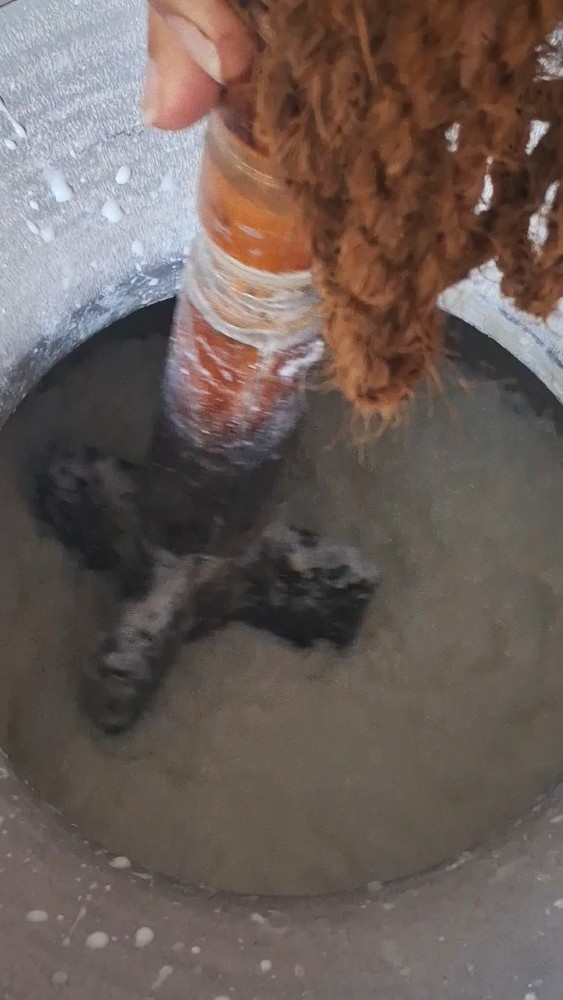
The milk must remain whole. Cream and all. Fermentation begins with a ladle of friendly bacteria borrowed from an existing batch of curd. Milk becomes curd. Curd becomes something more serious. Then comes the churning. An upper-body village workout. Arms brace. Shoulders relaxes.
The rope pulls, releases, pulls.
Swish, swosh, swish, swosh.
Forward, back. Back, forward.
Again. The rope pulls, releases, pulls.
This is not polite stirring. This is persuasion, stubborn repetition, and negotiation with the laws of physics. Butter does not reveal itself without effort.
Eventually, the great split occurs. Butter rises, pale and triumphant, while buttermilk settles below, humble. Pure fat floats. The rest step aside. The butter is carried to the fire where patience is tested once more.
Stir, stir, stir.
Wait.
Stir again.
Watch. Foam rises and falls. Colour deepens.
Somewhere between flame and hand, what emerges, after much tending, is ghee. Golden. A liquid so prized here it may as well be edible gold.




And somewhere in this rhythmic labour, Kali chewing thoughtfully nearby, the myth returns as if it had never left.
Long before butter knew it wanted to be ghee, the universe itself faced a dairy problem. The Mahabharata tells us that once upon a cosmic afternoon, the devas and asuras discovered an inconvenient truth: immortality does not arrive by polite request. It must be extracted. Preferably from a very large body of milk. The Ocean of Milk was requisitioned. Mount Mandara was borrowed as a churning rod. The great serpent Vasuki was promoted to the rope. This, incidentally, demonstrates how many important jobs in the universe are filled. Something large leans against something larger, and a snake is asked to help.
In cosmology, there is a theory that this churning is not merely myth but mechanics. The mountain is the axis. The ocean is the primordial field. The churning is energy applied to stillness. Creation, it turns out, does not begin with light, but with friction.
Devas pull.
Asuras pull back.
Back and forth the universe goes.
From that cosmic churn rose poison and nectar,
chaos and immortality,
riches and responsibility.
Nothing arrives gently. Everything arrived through effort.
What we do in the village feels like a domestic echo of that ancient scene. The same truth scaled to arms and rope and buffalo patience. You churn long enough, something precious surfaces. You apply heat carefully, and it clarifies. Leave it unattended, and it burns.
Kali does not concern herself with myth but she understands the principle. She chews. She gives. She demands space. She teaches abundance without sentimentality. Milk is plentiful, but only if you show up for the work that follows.
The universe did it first.
We are merely following instructions.