It has been two months since we made our big move to Astam, a hamlet tucked under the embrace of the Annapurna. Time here does not move in dates but in the length of the shadows across the terraces, in the slow turning of soil, in the way wind carries the smell of woodsmoke.
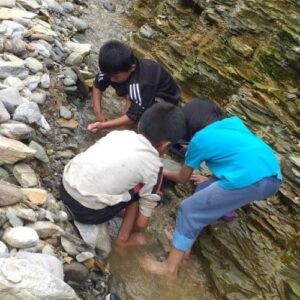
The boys, to our surprise, slip into this new life seamlessly, like water flowing into new banks. Astam becomes a new adventure. They take to the freezing water, the long walks, the unfamiliar faces, with a lightness I could not always summon for myself. On mornings when the icy wind comes rushing down from the snow peaks and settles into the bones, I find courage in their ability to accept the day exactly as it arrives. We are learning, all of us, to move one step at a time, trusting that the path will hold us. And slowly, the edges of unfamiliarity began to soften.
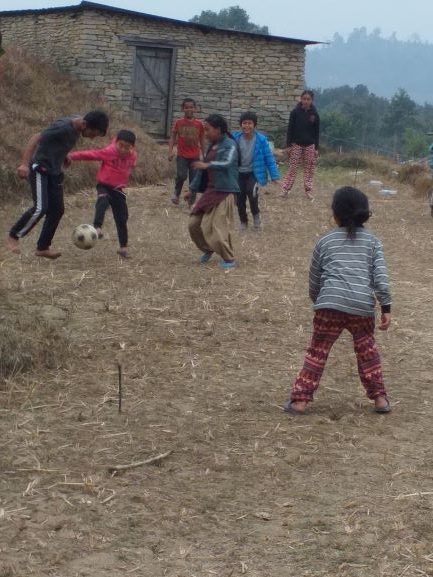
Language, I discover, transcends all barriers when a football appears in the scene. We got them a football from Hemje in the second week and it magnetises the village children, turning the terraces into a gathering ground. Children appear as if called by some ancient signal drifting in from houses scattered around the hillside, some barefoot, some in oversized slippers, all ready to play. The ball erases the need for translation. Every afternoon, the game goes on after the sun sets. We hear them; their voices float in the dark but we cannot see them.

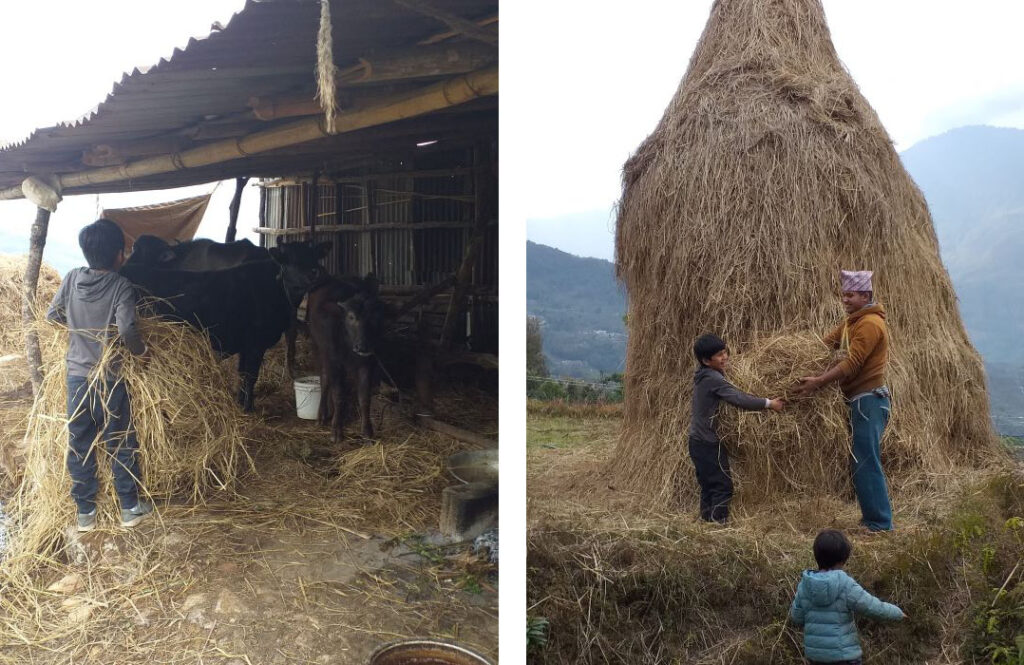
Little A finds new companions in the animals. His new love is a baby goat. He feeds her with fresh leaves in the morning and evening and runs beside her when the small burst of energy overtakes them both. His love affair, over time, has extended to Madam Buffalo, Madam Cow and her beloved calf, Kali. Suddenly, the haystacks, once only hiding places begin to make real sense to them. They are no longer props for play but stores of winter, stacks of labour, and survival here depended on what had been gathered and kept.
One afternoon, Big A, totally unaware of being in the right place and the right time, witnessed the birth of two baby goats. He watched the whole thing unfold with a kind of stunned fascination. The speed of it, the lack of fuss, the way life arrives. I wonder why humans have made such a complicated business of it all. The next morning, he learned the other half of the lesson. Only one calf survived the night. The other was taken away by a wildcat. I was grateful he had seen both with his own eyes. It spared me the clumsy task of explaining how life begins and how easily it can end. After it had all settled in his mind, he declared the entire process rather revolting and concluded with the certainty only a child can possess – that the idea of having children in his own adulthood was deeply questionable. The mountains, it seemed, had given him his first lesson in biology.
Spring finally arrives after a cold winter. The bitter edge of winter loosened. The winds from the snow caps came sweeping down the valley. With the warmth came movement everywhere. Bees and butterflies appeared first, followed by flies, dragonflies and mosquitoes, and creatures whose names we did not know but whose presence we felt all the same. One evening, we noticed the first swarm of termites rising from the earth in a sudden cloud, their brief flight a reminder that even the smallest lives here follow laws older than anything we understand. We found that the termites did not always require males to build colonies.
Our days began to revolve around the garden. Harvesting vegetables was no longer an activity but a necessity, and with necessity came a quiet kind of satisfaction. Little A, who had always loved carrots, could hardly believe that they truly came from the ground, that all one had to do was pull at the leafy top and the earth would give them up. When the munchies came, he’d pluck tomatoes warm from the sun, sweet pea pods and handfuls of wild yellow berries.
The villagers called them aiselu, a shrub native to these hills, its fruit small and bright and irresistible to birds, animals and boys with empty stomachs. Greens went from soil to wok in the space of minutes, and eggs, if we wanted them, had to be collected by hand from chickens who guarded them with determination.
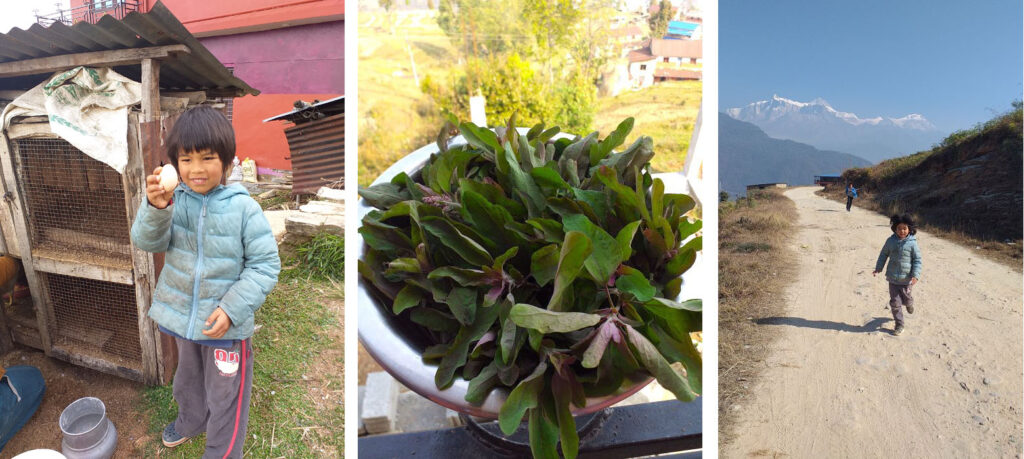
Coming from the city, I felt clumsy more often than not, aware of how little I knew about the simplest things. Here, knowledge lived in hands rather than in books, and the villagers carried it naturally. Our hosts shared what they grew, what they milked, what they gathered, never making it seem like generosity, only the natural order of living close to the land. Every meal arrives with effort, and that effort when shared, tasted different.
There is still much to do in the fields before the monsoon arrives in June. We know, even then, that what we were living through could not be told all at once. It would come in pieces, in small slices, the way life here reveals itself. One season, one lesson at a time.

iiling@cloudsontour.com
17 Apr 2020We are coping Raja! Hope it’s the same on your end.
Li Yen
9 Apr 2020What an adventure for all of you! And what interesting timing too! Just as the rest of the world is on a reset mode as well.
Lovely to read about your fresh new experiences and to know that all is well there! ❤️🌟
KS
8 Apr 2020Happy to see the boys in the pictures. Their smiles are the same as we can recall. 👍
iiling@cloudsontour.com
7 Apr 2020Hello other A! You had better have Enigma when you visit us!
Dy
7 Apr 2020My heart feels full reading of your adventures and how the children are learning so much. How lovely it must be for them to roam freely in such a large playground/school of nature. I so look forward to coming to visit and picking and snacking on fruits and veggies from the land.
Jia
7 Apr 2020Love the simple life. The cause and effect lessons. And all the nature!
Raja
7 Apr 2020Amazing!!!! Hope all is good with this darn virus!
Ezrina
7 Apr 2020hi the two of you do you like living in Nepal. It’s the other A – your friend in SD2. I miss you so much. Maybe next time you visit we can play video games together.
Your new place looks so nice.